Only 23 percent of Britons want an elected head of state, yet a persistent one-third still view the royal family unfavourably. That gap between grudging tolerance and genuine enthusiasm is the clearest evidence yet that the delicate bargain of the British monarchy is holding, but only just. It is not a story of collapse or triumph. It is a story of a institution surviving on conditional goodwill, propped up by King Charles’s personal popularity and a cultural role that money alone cannot buy.
Polling through 2026 paints a consistent picture: most Britons want to keep the Crown, most think it offers reasonable value, and most feel some pride in it. But those majorities are thin enough that a single scandal, a funding row, or a family rupture could shift the balance. This is the essence of the delicate bargain of the British monarchy: public consent that must be renewed, not assumed.
Key Takeaways
- Support for keeping the monarchy has held steady at 61-67 percent through 2026, with about 23 percent consistently favouring an elected head of state.[3][7]
- Roughly 57-60 percent of Britons view the royal family favourably, while 32-36 percent remain critical, showing the delicate bargain of the British monarchy rests on a narrow majority.[2][3][7]
- Perceptions of value for money have improved slightly, from 51 percent in January to 54 percent in July 2026, though nearly a third still call it a poor deal.[3][7]
- King Charles’s personal approval hit 68 percent in July 2026, the highest recorded, giving the institution a stronger buffer against criticism.[3]
- Boundaries around Harry and Meghan, and renewed scrutiny of past royal conduct, show how quickly public trust can be tested.[1][5][12][14]
Why Public Opinion Still Favours the Crown
Support for the monarchy has not collapsed, but it has never been overwhelming either. Across January, April, and July 2026, YouGov tracking found 64 percent of Britons wanted the UK to remain a kingdom, a figure that has stayed within a 61 to 67 percent range throughout Charles’s reign.[2][3][7] That stability suggests a durable, if not enthusiastic, consensus.
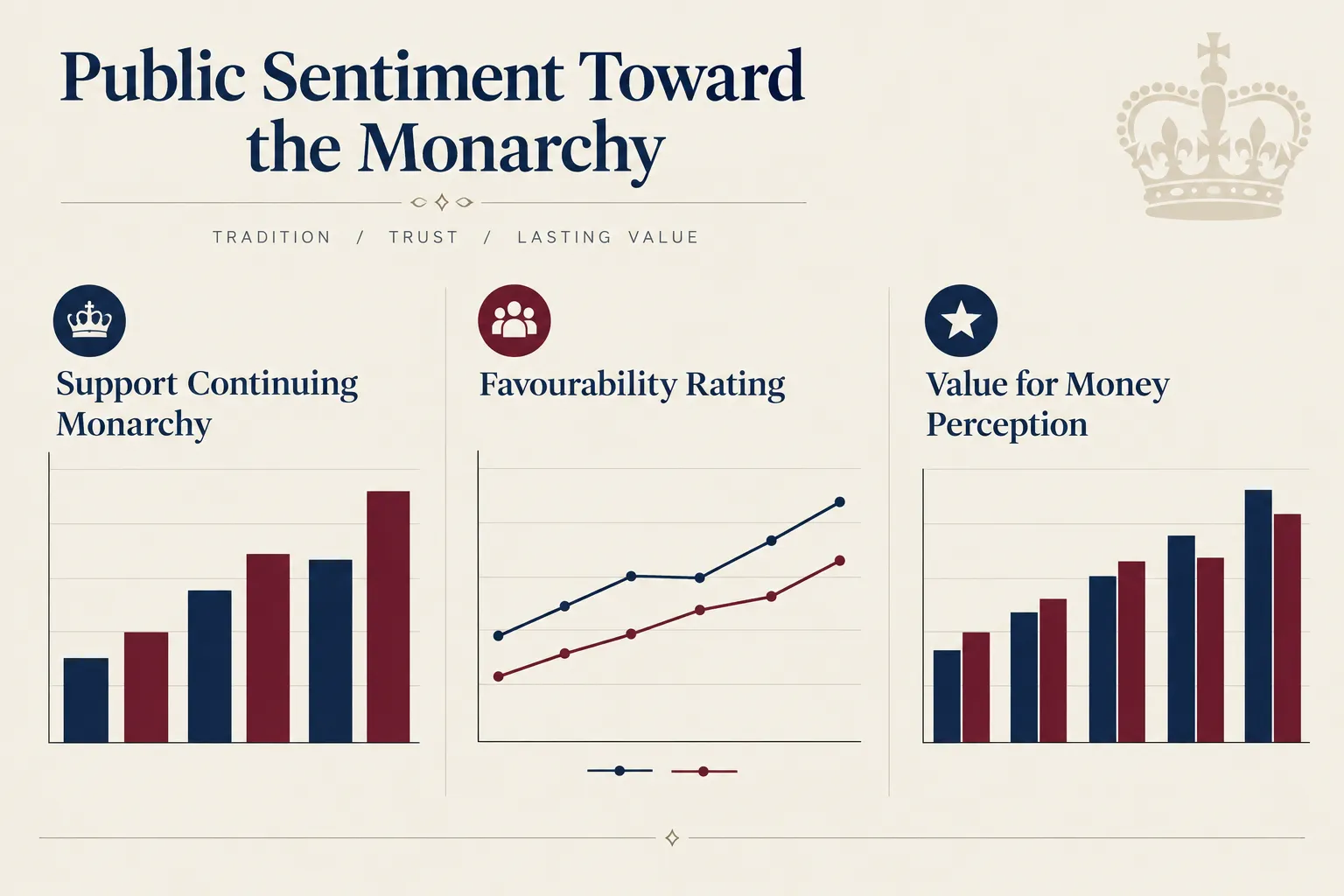
Around 23 percent consistently say they would prefer an elected head of state, a figure that has not meaningfully shrunk.[3][7] Favourability ratings tell a similar story: 57 to 60 percent of Britons view both the royal family and the institution positively, while 32 to 36 percent take a negative view.[2][3][7] This is where the delicate bargain of the British monarchy becomes visible in the data. A majority is comfortable, but a substantial minority is not, and that minority has proven remarkably persistent across recent years.
Ipsos polling from February 2026 adds a fresh wrinkle. Only 37 percent of Britons said abolishing the monarchy would be worse for Britain’s future, down sharply from 47 percent in November 2025.[6] Fewer people now see the Crown as essential, even if most still see it as beneficial. That distinction matters for the monarchy’s long-term standing.
The Financial Side of the Delicate Bargain of the British Monarchy
Money remains the most tangible test of public patience. In January 2026, about 51 percent of Britons felt the monarchy offered good value for the cost of the Sovereign Grant, against 33 percent who disagreed.[7] By July, that had edged up to 54 percent versus 31 percent, a modest but real improvement.[3]
This is not a landslide verdict. It suggests the institution is winning the financial argument narrowly rather than decisively. Emotional attachment follows a similar split: nearly half of Britons, 47 percent, reported feeling proud of the monarchy in both January and July 2026, while 17 to 20 percent said they felt embarrassed, and roughly a third remained neutral.[2][3][7] Pride, discomfort, and indifference all coexist within the same population, which is precisely why the arrangement is described as delicate rather than settled.
Family Boundaries and the Cost of Trust
Nowhere is the bargain more visible than in how the monarchy manages its own family. A letter sent on behalf of King Charles in early September 2026 confirmed that Prince Harry and Meghan remain non-working royals, will not resume official duties, and continue to avoid using royal titles.[12][14] The letter made clear that any charity work they do is private, and that security arrangements fall to police agencies rather than palace resources.[12][14][15]
By mid-September, reporting noted the couple had returned to the UK for an extended stay but would live in a private residence outside London, described as “akin to private citizens,” while keeping homes in California and Portugal.[15] This arrangement draws a firm line: public status and public money must track official duty, nothing more.
That same week brought renewed scrutiny of the King’s past, with headlines revisiting old allegations about comments toward Princess Diana and fresh claims from Earl Spencer about events following her death.[1][5] Reuters described it as a “trying” week for Charles, a reminder that history can resurface at any moment and test public tolerance anew.[1]
Soft Power as Currency
The monarchy increasingly justifies itself through cultural and moral leadership rather than constitutional necessity alone. On 17 September 2026, King Charles convened an AI summit in London, urging executives from OpenAI, Anthropic, Google DeepMind, and Nvidia to keep artificial intelligence under control, calling the pace of development “both intriguing and deeply concerning.”[9][11][13] Days earlier, the royal website highlighted his speech at a Bayeux Tapestry exhibition, reinforcing his role as a custodian of shared European heritage.[8]
Both moments illustrate the non-financial half of the delicate bargain of the British monarchy: influence, continuity, and moral voice offered in exchange for public trust and funding.
The evidence from 2026 shows a monarchy that remains popular but never complacent. Majorities support it, value it, and feel some pride in it, yet sizeable minorities do not, and that tension is unlikely to disappear. King Charles’s rising personal approval, firmer boundaries around Harry and Meghan, and forays into issues like artificial intelligence all represent active efforts to keep the arrangement in the public’s favour. Anyone following the institution’s future should watch three signals closely: value-for-money polling, personal approval of the King, and how the family handles internal disputes. Those three measures, more than tradition alone, will decide whether the delicate bargain of the British monarchy holds for the next decade.
References
[1] Diana Revelations Harry Return Give King Charles Testing Week 2026 09 17 – https://www.reuters.com/world/uk/diana-revelations-harry-return-give-king-charles-testing-week-2026-09-17/ [2] 54571 Royal Family Favourability Trackers April 2026 – https://yougov.com/en-gb/articles/54571-royal-family-favourability-trackers-april-2026 [3] 55269 Royal Family Favourability Trackers July 2026 – https://yougov.com/en-gb/articles/55269-royal-family-favourability-trackers-july-2026 [5] Prince Charles – https://www.theguardian.com/uk/prince-charles [6] Ipsos%20uk%20feb%202026 Royals%20polling%20charts V1d5 Client%20use%20only – https://www.ipsos.com/sites/default/files/ct/news/documents/2026-02/Ipsos%20UK%20Feb%202026_Royals%20polling%20charts_V1D5_CLIENT%20USE%20ONLY.pdf [7] 53895 Royal Family Favourability Trackers January 2026 – https://yougov.com/en-gb/articles/53895-royal-family-favourability-trackers-january-2026 [8] The King 0 – https://www.royal.uk/the-king-0 [9] King Ai Uk Monarch Charles Meets Artificial Intelligence 136546409 – https://abcnews.com/Lifestyle/wireStory/king-ai-uk-monarch-charles-meets-artificial-intelligence-136546409